ICTEC2000, USA: the INTELLECT project presentation in Dallas
November 16-19, 2000
Over the past few years, electronic commerce (EC) has emerged as a dramatic new mode of business. Today, almost every company is either using or considering EC. Also, advances in telecommunications and automated processes are already forcing dramatic changes in a variety of industries, ranging from banking and finance to music and entertainment. Yet, the TEC (telecommunications and electronic commerce) environment is still in a relatively early state of evolution, and many of the significant advances in understanding and implementing TEC are occurring concurrently in academia and industry. The traditional sequential process of technology innovation followed by technology transfer no longer applies. Thus, dialogue on this field between academia and industry is important. As TEC spans a wide range of reference disciplines, forums focusing on TEC are necessary to stimulate the necessary interactions and knowledge sharing across this broad community.
ICTEC00 is intended to address these needs. Following on the heels of the successful second conference in 1999, the goal of the conference is to bring together both academic and industrial researchers in the fields of telecommunications and EC on an ongoing, annual basis, to discuss new technological developments and their implications for TEC, as well as technological issues that need to be addressed to further the effectiveness and efficiency of TEC. The conference combines research tracks in which technical papers will be presented, with industrial tracks consisting of panels and plenary speakers.
New approaches for the Internet: Auctions and Extranet
Today the central model of the Internet is ineffectively. Thus models are characterised by the fact that the security and authentication are guaranteed, which are kept data central with monitoring functionality and following of transactions. But now, the decentralised model should be used in the Internet, but there is still no umbrella security available.
Today subjective standards will be used to determine the value of an enterprise, share or easily a product. More interesting would be to use the Internet and organised auctions in order to determine the "real" value of e.g. a company. Auctions contain the following capability characteristics:
- Many-to-many communication: create values, because it contains a singular functionality
- Online transaction: Added values are the key for the convenience of the customer
- Dynamic price structure: Auctions ask continuously after the demand
- Added values: depend on as pay much the customer for it wants
- Security: depends of the users requirements
Through this points, there are new tasks for the offer of the Internet. For instance, auctions have an extreme asymmetric behaviour, because one supplier and many buyers are available. Today prices and offers are well-known, but additional information is missing to advise the customer and use its buying behaviour. Therefore, is has to be use benchmarking, tests, and comparisions independent from the manufacturers/vendors. Open questions from the point-of-view of auction houses are security, bandwidth, and availability. These subjects must be available in the Internet. The conclusion is: auctions can help to determine the real value, which the users want to pay. Additionally, you get a static value for the investor without fluctuations.

Figure 1: Dallas, Texas -
place of the event of the ICTEC2000
In the near future, Extranet platforms must established to support distributed processes in the Internet. Four years ago, the Automotive Network eXchange (ANX) was started in the USA. Today the ANX will be shifted from the academic in the commercial site. The Automotive Industry Action Group (AIAG) works as non-profit organisation and is responsible for the ANX. Currently working groups are ECommerce, EDI, SML/EDI, directory services, collaboration, and security. The developed standards from this groups will be co-ordinated with Odette in Europe and JAMA in Japan. Other standardisation committees are also included. Today, the main goals of the ANX are:
- Establish marketplaces and portal sites for the automobile industry
- Reduction of the development cycles from 42 month to 12-18 month
- Immediately delivery on demand regarding ordering processes
Since May 2000, the automobile network is extended by COVISENT and by further partners like Renault. COVISENT is a customer of the ANX and offer an Internet platform, which should be a common base for all trade partners. The following services will be offering:
- E-Selling
- E-Procurement
- Collaborative E-Engineering
- CAD
- EDI
- Portal Service
- Videoconferencing
- Electronic Whiteboard
- Voice-over-IP

Figure 2: Cox School of Business at Southern
Methodist University (place of the event)
Development in other countries
In contrast to the USA other countries have still the problem that eCommerce is still in the beginning. For instance, in Hong Kong 54% of the people have a computer, from this among 62% use an online access, and from this again 82% use it for business. However, the infrastructure is substantially better as in the USA, because each house has access via glass fibre. Though, an increase of Internet user can be detected: in 1998 in Hong Kong 110000 customers used online business, one year before it were only 50.000 people. Today, 6,6 million people of 460000 households use the Internet very strong. This people cause approx. one million transactions via eBusiness.
The European community has another point-of-view. They see in the business model more as a pure shop solution. Besides the eShops there are the following subjects important:
- eProcurement
- eMall
- eMarketplace
- Virtual Community
- Value chain service provider
- Value chain integrator
- Collaboration platforms
- Information brokerage
- Trust services
Likewise eCommerce goes toward small and medium enterprises (SME's), because new customer markets arise, low-cost systems can be used, new potentials are available, and automated business processes can be established. On this occasion, the time is critical and must be noticed to react fast on the market, reduce time-to-market, get higher flexibility, or handle order processing efficiently. SME's have big advantages in the relationship against larger companies, because they are smaller, faster, and more flexible. But critical success factors have to be keep in mind:
- adequate technology
- competitive contents
- eTrading and globalisation
- Customer satisfaction
- eCommerce community
- Integration into the traditional business processes
Risks are still security (payment, authorisation, access, virus...), missing management support, and political and cultural barriers. Additionally, SME's offer their products from a market niche. But now, they are via the Internet in a global market, and perhaps they can lose their niche to bigger companies who offer the same product in another part of the world. This must be take into account for the planning of an online presence.
In Canada the Internet users are also in higher number available. However, the education status of the users is high and they have additionally a high income. It is necessary for the inclusion of different social classes to include a graphical user interface (GUI), which is able to support different languages, gestures, mobile devices, and establish improvements of the combination between transaction and co-operation. Additionally, there are too many data available, why the customer is not able to find the right information. Social and cultural impacts are also not take into account, yet.
Development of eCommerce
The eCommerce development will be seen different in the United States. On the one site, the opponent see the obstacles which are critical for the successful mass-market. For instance, web-shopping today is only a buying from a 2D catalogue. The advantages of an online process behind the order of the customer like guaranteed supply, quick feedback, status of the delivery, price information etc. are used, but are not always offered in a sufficient quality. The availability of the supplier and the security is also not always guaranteed. Furthermore, the perception of the products, shopping experience, and service quality are important and influence the customer in its purchase intention. The customer must get more convenience and the availability of the supplier has to be guaranteed.
On the other hand, the United States see a trend from eCommerce to mCommerce. The number of mobile users increased in the same way as the Internet users. But today, it gives more mobile users as Internet users. This relationship is identically in the USA and Europe. The number of Internet user is approx. 200 millions in 2000 and will increase to 500 millions in 2003. The mobile users are actually 300 millions and will go up 1000 millions in 2005. This user group has to take into account. With the combination of fixed networks and GSM (in the future UMTS) global communication is enabled, which involves a multi-level service competition. It has to be keep in mind, that mCommerce is not only mobile eCommerce, because there are several opportunities by the mobile aspect possible. For instance, mCommerce must react immediately and faster than eCommerce applications, because the user wants to get the information without time loss. Furthermore, there are other services conceivable, like push services, place-dependent services, and information services.
The WAP forum will also push this topics in the mCommerce area. The forum includes manufacturers, vendors, providers, users, and universities to develop fast new specifications for the wireless application protocol (WAP). Now, security is not well enough addressed. The following security features are necessary for the future:
- authentication
- integrity
- confidentiality
- communications authentication
- non-repudiation
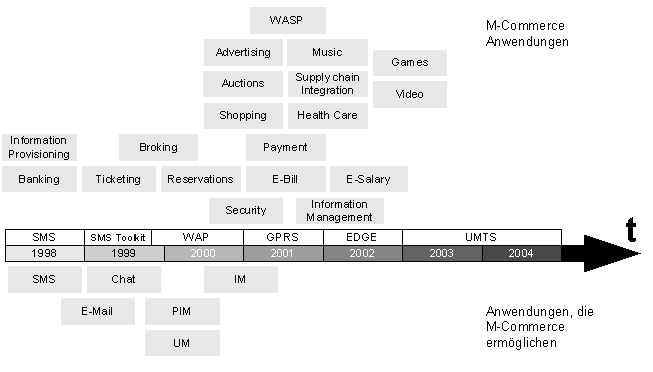
Figure 3: Development of mCommerce applications
Further reductions of mCommerce are the missing micro payment, storage of public keys in the terminals, small browser interface, missing symmetrical encoding functionality etc. Today, no mobile terminals are available, which is able to fulfil this requirements. The conclusion is, that time stamps for an electronic signature and the relation between certificates and code pairs for the user must be developed.

Figure 4: Skyscraper in the
downtown of Dallas
Commercialisation
The commercialisation of eCommerce solutions by an efficient marketing is another very important topic. Also in the new economy market it is very expensive to become the market leader. Everyone can establish a website today, but the suppliers are dependent from their own niche. If the supplier or provider will achieve the market leader the costs will dramatically increase. For instance, the web site amazon.com had marketing/sales costs of 431 million US Dollar in 1999 and 130 million US Dollar in the first three month of the year 2000. In 1996 the marketing costs were only at 6 million US Dollar. Each provider or supplier has to take this costs into account.
A successful marketing strategy is characterised by top of mine, awareness, trust and the brand name of the company. Naturally costs can be saved by the Internet (smaller overhead, price-conscious buyer), but the reality is that companies like Amazon did not reach the break-even point. Additionally, the performance of dot-com companies are bad in the business market, because 6 of 52 companies have only a positive net income in 2000, while one of 52 companies positive change their core business to eBusiness.
The indicators for the success should be determined (e.g. financial data of the yearly report, qualitative information concerning business models and business press) as well as different variables like financial indicators (changes of the market capitalisation) and qualitative indicators (existence of bad performance factors). In addition, the risk management is essential. Success factors for start-up companies get together from 15% technology, 35% marketing and 50% management. These success factors must be identified and be tested again and again in benchmarks. The risk management system should be seen as completion of the existing management system.
Summary
eCommerce and mCommerce will become more and more important for the consumer market. Actually, available problems should be eliminate in the future. The interactivity must be improve via shopping agents or intelligent search functions. Additionally, the configuration of products is important for the customers, because they want to play with the new product and configure its own wishes.
The main problem is, that the customers often does not find the information they wants. To many requests are necessary from the customer point-of-view to find the right product. Furthermore, the description of the product is not detail enough. Also the awareness of the customer has not been used. One solution is, to minimise the information, identifier the needed product and optimise the time costs. Additionally, intelligent agents can help, which implied the following points:
- Automatically learn of customer purchase targets
- Reduction of information costs (instead of pure time costs)
- Preserve the privacy of the customer
- Support processes for the customer
- Decoding of product information for simpler handling
- maximum product portfolio with the help agents