INTELLECT:
Second technical meeting in Vienna
On 12.-14 April the second technical meeting
in the project INTELLECT took place in Vienna. The second meeting was located
completely in the character of the specification of the module interfaces, which
are used in the INTELLECT Shop. All partners, which are entrusted with the technical
conception, were present. There were the actual INTELLECT user too, which stated
their own request in detail again.
Specification
of the modules
On the first day the pending Deliverables
was discussed, on the entire second day the in-terfaces and modules of INTELLECT
were discussed in a 12 hours session. It came to the following final result
of the specifications:
- The e-shop can have two definitions depending on
the point of view:
- from the user point of view, the e-shop is the place which describe the
products and which allows ordering them,
- from the developer point of view, it is the infrastructure that defines
all the functions required to run the shop and interact with the customer.
- The configuration module (or configurator) is the
module in charge of defining the possible configurations of products. All
the products are assumed as configurable products. The configurator also contains
a set of pre-configured product that can be modified by the user or ordered
as it is. To avoid inconsistency, the customer never start configuring an
empty product; he has to select a pre-configured product, and then he can
change some components or their properties.
- The 3D module can be assumed as an interface to
the configuration module. It shows a 3D view of the pre-configured product
and allows its configuration. When the user selects a component of the product,
the 3D module ask the configurator for the possible modifications and allows
the user to choose one of them. Excepted few cases where the configurator
has the possibility to directly adapt a pre-configured product for a customer
(changing the size for example), the customer must go into the 3D module to
configure its product.
- The help desk allows the customer to communicate
with an assistant. When the customer needs help, he can ask for help, and
is put in relation with an assistant who gives him some information according
to his situation and needs.
- The order-processing module is the link between
the shop and the back-office system. It can check if a product or a component
is available, and proceed the order. It gives the customer a confirmation.
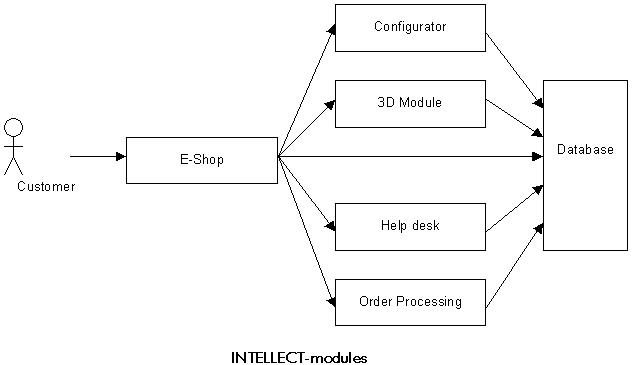
Database application The e-shop contains only one central
database containing all data, in which every module could access without any
rule. The partner OptiNet/WWL is responsible for the database design, because
the e-shop can be assumed as an interface between the product and the customer,
so it is more relevant that the database belongs to the e-shop than to another
module even if the configurator needs also to access very often to the database.
Finally, the database will be divided into several parts. Each module will be
in charge of one part of the database, according to its special needs, the other
modules cannot access this part of the database directly; they have to ask the
responsible module for the information it contains.
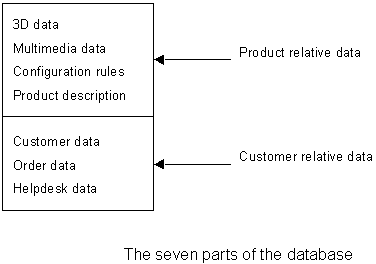
The database
contains two data types:
- the customer information contains all the data relative to the customers (registration
information, size, weight, previous orders…);
- and the product information contains all the data relative to the products
and components (prices, multimedia data, 3D representation…).
The database
can be divided into seven parts, as shown in the following diagram:
The functionality of the total system will determine
the data exchanged between the different modules. The data exchanged between
two modules can be from five types:
- The customer data is the responsibility of the e-shop.
If another product needs it, it has to ask the e-shop.
- The product key is a reference to the product.
- The component list is a list of components that
makes up a product.
- The possible components/features is a list given
by the configurator that can change a component or its attributes.
- The availability data or back-office data are checked
by the order-processing module and send to the help-desk or to the configurator.
The 3D-Interface communicates with the e-Shop by the
product configuration key and receives the data of the customer. Thereby the
product configuration data can be also transmitted to the Help Desk. The e-Shop
is likewise in a position to access direct the Help Desk system and to help
the customer with the product configuration. On this way also customer data
is transmitted to the Help Desk system. The 3D-Interface exchanges itself however
with the configuration module very strongly, regarding component list, product
configuration, possible component/features and customer data.
Also the configuration module is very strongly merged
into the order processing, which appends to the Back Office System. In this
area customer data, Back Office data, component/features and component lists
were exchanged. The configuration module is likewise merged into the Help Desk
system. Within this area component lists and product configurations are exchanged.
The Back Office attributes were transmitted by order processing to the Help
Desk system. The e-Shop forwards product configuration data and the customer
data to all modules.
General
operation functions of the Modules
E-shop
- Navigation
- Basket
- Catalogue (product information and comments)
- Customer registration
- Personalisation
- Localisation
- Indexed search
- Secure communications
- User Interface for payment
- Multimedia presentations
- General user interface
- User behaviour analyses
- Administration
- News and customisable community issues (low priority)
Configurator
- Serving interfaces
- attributes calculation
Order-processing
module
- Back-office systems integration
- Order status maintenance
- Payment
- Administration
- Communication with customers/suppliers
- Availability information
- Workflow control
- Order archive (clean configurator)
Help-desk
- Communication (chat, voice over IP, video conference)
- Browser mirroring/synchronising
- Shared workspace
- Help-desk agent user interface
- Incident logging
3D Module
- Navigation (zoom, rotate, predefined point of view)
- Change component (add, delete only if allowed by
the configurator)
- Add/delete avatar
- Play (avatar) simulation
- Display non 3D information (general description
of components)
- Call basket functions
- Save/delete configuration
User
demands
On the third day in Vienna the user demands of the
individual partners of INTELLECT were discussed. It was determined that it concerns
three different scenarios, which will increase the expenditure of work in the
project.
| Demands |
Blauwerk |
HiTec |
Interset |
| Distributors |
- Different dis-tributors
- Everyone is responsible for its country
- Back-Office Information were transmitted to the e-Shop
|
- Different distributors
- HiTec act as a distributor, too
|
|
| Retailers |
- Sells the products
- If there are no retailer, Blauwerk sells the products
|
- Sells the products
- HiTec sells the products, too
|
- Sells the products
- Interset doesn't sell
- Dealer should have their own shops
|
| Back-Office Info |
- Dealer-list
- Order Processing info
- Stocks information
- Prices
- Help assistance
|
- Dealer-list
- Order Processing info
- Stocks information
- Prices
- Help assistance
|
- Dealer-list
- Order Processing info
- Stocks information
- Prices
- Help assistance
|
| E-Shop |
- Only one shop is required
- Contains data of the distributors
- Blauwerk keeps the responsibility
- Available for everyone
- Speech selection
- Country selection
|
- Adresses are available in the E-Shop
- Customer can decide buying from Hi-Tek or from a dealer
- Technicians have to check the inquires
|
- Interset has ist own shop
- The dealer can integrate their own prices or logos
|
| Product configuration |
- Configuration is possible
- Even if the product is not available
- It will be advised if the product is not available
|
- Configuration is possible
- Based mainly on the budget of the customer
- No configuration of all components possible
- Only groups of components
|
- Visualisation of the computer housings
- Other components should also be represented
- Configuration for the composition of new products
|
table 1: User demands of the INTELLECT-User
The next important steps made in the INTELLECT project
will be to combine these different and to make a detailed software/module specification.
Up to the next meeting in June there is a lot of work to do. In summary all
users of the technical meetings in Vienna were satisfied of the results of working
and a real project team was formed, which wants to achieve a common, positive
result of the project.